
The Mistake Almost Everyone Makes First
The door won't close all the way, or it reverses halfway down for no obvious reason, and someone grabs the opener manual, finds the little force dial or app setting, and cranks it up. It's tempting because it's right there, it's fast, and it usually "works" within seconds — the door finally closes. Problem solved, argument over, right?
Not quite. Force and travel limits are two different settings doing two different jobs, and increasing force to cover for a mechanical problem is like pressing harder on a sticky gas pedal instead of finding out why it's sticking. It fixes the symptom today and sets you up for a bent track, a cracked panel, or a door that comes down on a car bumper (or a kid, or a pet) without reversing.
What Travel Limits Actually Do
Travel limits tell the opener exactly where "fully open" and "fully closed" are. The motor runs until it hits that programmed stopping point, not until it senses the door is actually done moving. If the limit is set too short, the door stops a few inches before it's really closed, leaving a gap along the bottom. If it's set too long, the opener keeps pulling after the door is already shut, straining the top panel and the opener's drive mechanism.
Travel limits are about position. They don't know or care how much effort it took to get there.
What Force Settings Actually Do
Force is about effort. It tells the opener how hard to push or pull before deciding something is wrong and reversing direction. This is the opener's built-in safety check — if the door meets resistance beyond the force threshold (a toy, a foot, a frozen track), it's supposed to stop and reverse instead of continuing to push.
When you raise the force setting, you're not making the door travel further or sealing that gap at the bottom. You're telling the opener to tolerate more resistance before it reacts. That's exactly why it feels like a fix — the door muscles through whatever was stopping it. It's also exactly why it's dangerous: you've just dulled the safety feature that's supposed to protect people and property.
Why Cranking the Force Dial Is the Wrong Fix
If a door needs more force to close properly, something downstream is usually working against it:
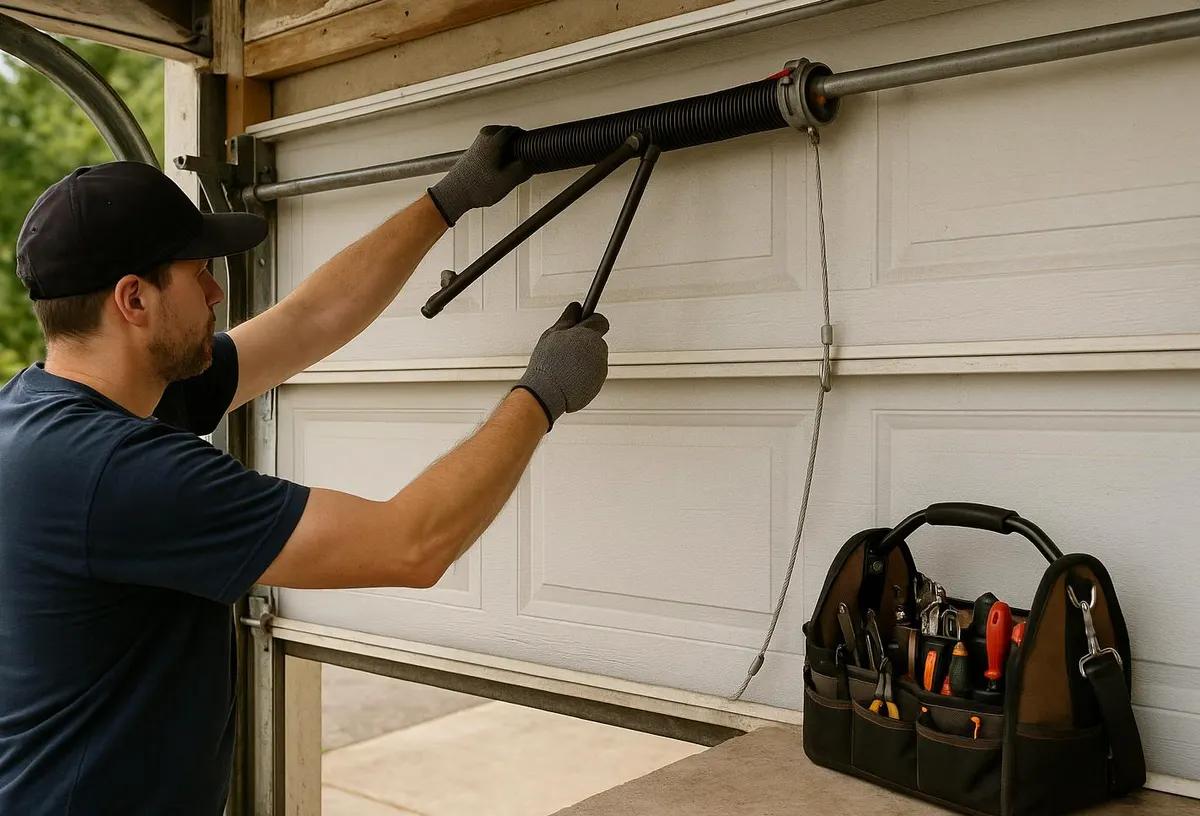
- Springs losing tension — the opener is doing work the springs used to do, which is not what openers are built for long-term.
- Track misalignment — the door is binding somewhere along its path, so the motor has to fight friction the whole way.
- Worn rollers or hinges — more drag means more resistance means more perceived "need" for force.
- A heavier or swollen door — common with wood or composite doors that have absorbed moisture.
Turning up the force papers over all of these. Meanwhile the opener's gears, belt or chain, and the door's panels and track absorb more stress every single cycle. Over months, that shows up as a stripped gear, a torn panel seam, or a track pulled loose from the wall.
How the Space Coast Climate Makes This Worse
Heat, humidity, and salt air aren't just background noise here — they directly change how much resistance a door puts up. Wood and composite doors swell in humid stretches and can drag against the track or weatherstripping, which looks exactly like a force problem but is really a moisture problem. Salt air near the coast speeds up rust on rollers, hinges, and spring coils, adding friction that wasn't there when the opener was first set up. And after any storm with heavy wind load, tracks can shift slightly even if nothing looks obviously broken — enough to change how much effort the door needs to travel smoothly.
In other words, a force setting that was correct in March can be wrong by August, and wrong again after the first named storm of the season. That's not an opener problem; that's a maintenance problem wearing an opener-setting disguise.
The Real Test
Before touching either setting, do a basic balance check: disconnect the opener (pull the release cord) and lift the door by hand halfway up. It should stay roughly in place with light resistance, not slam down or fly up. If it doesn't, the springs — not the opener — are the issue, and no amount of force or travel adjustment will fix that safely.
If the balance test passes, travel limits and force can be fine-tuned in small increments, testing after each change, watching for the door to close fully and reverse cleanly off a 2x4 or similar obstacle on the floor.
When to Call Melbourne Overhead Door Co
If the balance test fails, if the door needs real muscle to open or close by hand, or if you've already adjusted the force dial and it still doesn't seem right, that's the point to stop guessing. Our Preventive Maintenance & Tune-Ups service checks spring tension, track alignment, and opener calibration together, so the settings match the actual condition of the door instead of masking a problem. If springs are worn or rusted from salt air, our Garage Door Spring Repair service handles that directly, which is almost always the right fix instead of leaning harder on the opener.
If your garage door in Melbourne, Palm Bay, Satellite Beach, or anywhere else on the Space Coast is fighting you on open or close, give Melbourne Overhead Door Co a call — we'll find out what's actually causing the resistance before anyone touches that dial again.